Admiral Bill Halsey by Thomas Alexander Hughes
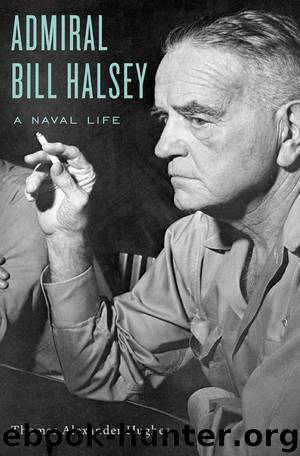
Author:Thomas Alexander Hughes [Hughes, Thomas Alexander]
Language: eng
Format: azw3
ISBN: 9780674969292
Publisher: Harvard University Press
Published: 2016-05-02T04:00:00+00:00
This was the perspective he would have conveyed to staff officers unhappy with his adjudication of the salacious cases. By the summer of 1943, the twenty-five men Halsey had brought ashore the previous November had swelled to over 300, 95 percent of whom were naval officers, most of the rest Marines, and just two who wore Army khaki. In early 1943 came a deputy commander, Rear Admiral Theodore “Ping” Wilkinson, who had won the Medal of Honor for bravery off the coast of Veracruz in 1914 and had an excellent reputation within the Navy. Many others reaching Halsey’s inner circle did so upon compatible personalities as much as vocational capacity. His prewar cohort of Browning, Ashford, Dow, and Moulton had already grown with the arrival of Herb Carroll, the admiral’s yeoman, Benedicto Tulao, the admiral’s mess attendant, and William Kitchell, by 1943 well established as Halsey’s flag lieutenant. Others now followed. Lieutenant Commander Gene Markey, a screenwriter, movie producer, and husband to some of Hollywood’s great beauties, including Joan Bennett, Hedy Lamarr, and Myrna Loy, was for a time Halsey’s assistant intelligence officer, and Robert Montgomery, a prominent actor already nominated twice for Academy Awards, served on the South Pacific staff before transfer to the European theater. Halsey collected people, and he often held fast to those who fit his temperament: Dow and Moulton stayed with him to the end of the war, Tulao until Halsey retired, Kitchell and Carroll to Halsey’s death, and Markey and Montgomery beyond even the grave—Markey, as a business partner with Halsey’s son, and Montgomery, as the producer of The Gallant Hours, a 1960 film starring James Cagney that depicted Halsey’s command of the Guadalcanal fight.37
As Halsey’s command grew, his inner circle of associates shrank. This was the result of the rigors of wartime work and the intense personal loyalties Halsey elicited. As was his wont, he usually embraced a handful of valued men and then spoiled them. In fitness reports Halsey wrote that Ashford had “excellent military and personal character”; Kitchell had taken to naval life with “ability, adaptability, interest, and enthusiasm”; Moulton was “superior in every respect”; and Dow was “well balanced,” had “a keen grasp and excellent military judgment,” and, like Moulton, was “superior in every respect.” Halsey’s men returned his devotion, sometimes to the point of hero worship. By the middle of the war, Ashford believed Halsey was a “very good” pilot, a preposterous judgment, and by the end of the war another believed Halsey’s “whole mob” was “so vigorously loyal” to the admiral “that nothing should be permitted to ever dim that feeling.”38
Sometime in the spring of 1943 this admirable sentiment began to erode the free and frank exchange of ideas upon which Halsey’s command and leadership had always relied. As early as December, Halsey battled the Navy to get Commander Oliver “Scrappy” Kessing, one of his “oldest and best friends” but a well-known drinker throughout the Navy, promoted to captain and transferred from sleepy duty as an ROTC instructor to take command of the burgeoning Guadalcanal naval base.
Download
This site does not store any files on its server. We only index and link to content provided by other sites. Please contact the content providers to delete copyright contents if any and email us, we'll remove relevant links or contents immediately.
| Africa | Americas |
| Arctic & Antarctica | Asia |
| Australia & Oceania | Europe |
| Middle East | Russia |
| United States | World |
| Ancient Civilizations | Military |
| Historical Study & Educational Resources |
The Radium Girls by Kate Moore(12093)
100 Deadly Skills by Clint Emerson(4972)
Rise and Kill First by Ronen Bergman(4838)
The Templars by Dan Jones(4735)
The Doomsday Machine by Daniel Ellsberg(4545)
The Rape of Nanking by Iris Chang(4255)
Killing England by Bill O'Reilly(4042)
Stalin by Stephen Kotkin(4006)
Hitler in Los Angeles by Steven J. Ross(3978)
12 Strong by Doug Stanton(3575)
Hitler's Monsters by Eric Kurlander(3385)
The Code Book by Simon Singh(3251)
Blood and Sand by Alex Von Tunzelmann(3240)
Darkest Hour by Anthony McCarten(3161)
The Art of War Visualized by Jessica Hagy(3043)
Hitler's Flying Saucers: A Guide to German Flying Discs of the Second World War by Stevens Henry(2777)
Babylon's Ark by Lawrence Anthony(2718)
Tobruk by Peter Fitzsimons(2559)
The Second World Wars by Victor Davis Hanson(2554)
